
How Is Social Media Affecting Teen Girls’ Mental Health in 2026?
Social media can affect teen girls’ mental health by increasing social comparison, sleep disruption, exposure to cyberbullying, pressure to gain approval, and feelings of exclusion. In 2026, research continues to show that girls report negative effects more often than boys. However, social media can also provide friendship, creativity, community, and emotional support, so its impact depends on how a teen uses it and how it affects her daily life.
For parents, the challenge is not simply determining how many hours their daughter spends online. It is also understanding what happens to a child’s mood, confidence, sleep, relationships, and behavior because of those experiences. At Orama Residential Treatment Center, we understand how complicated adolescent mental health can become when online pressures overlap with anxiety, depression, trauma, self-harm, substance use, or relationship struggles. Orama provides compassionate, trauma-informed residential treatment for adolescent girls ages 13 to 17, combining evidence-based care with family involvement, structure, and relationship-centered support. The goal is not simply to remove access to a phone or social media account, but to help girls develop healthier ways to cope, connect, and build confidence.
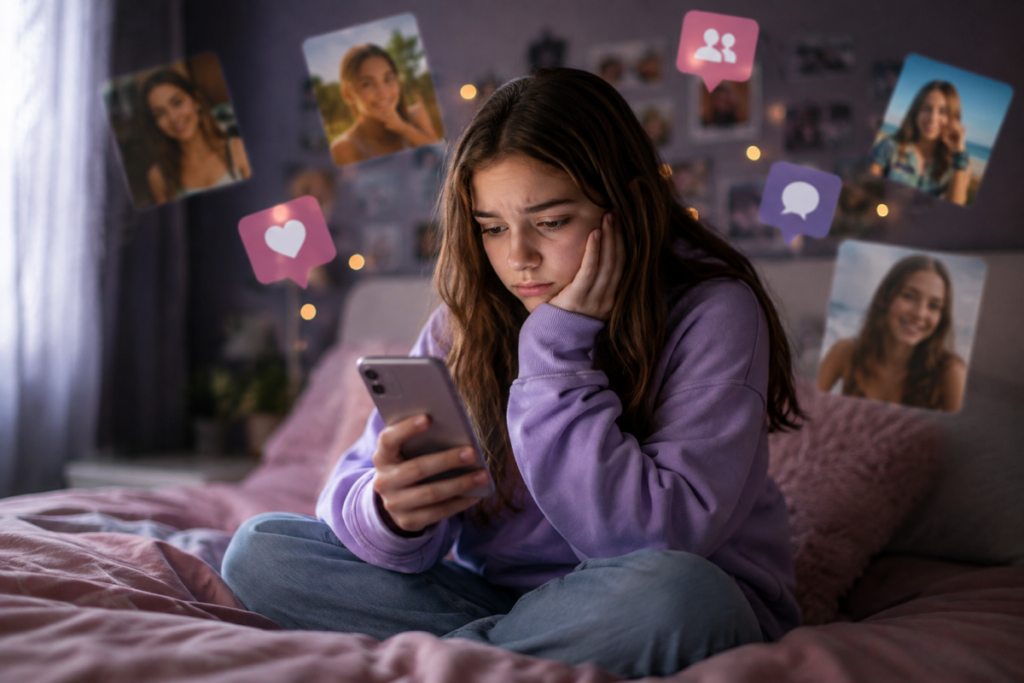
Social Media and Teen Girls’ Mental Health: What Parents Should Know
Social media itself is not universally harmful or helpful. The more important question is how a particular teen experiences it.
According to Pew Research Center’s 2025 research, teen girls were more likely than boys to say social media hurt their mental health (25% compared with 14%), confidence (20% compared with 10%), and sleep (50% compared with 40%). Girls were also more likely to report feeling overwhelmed by online drama and being excluded by friends.
At the same time, social media has genuine benefits. Pew found that girls were more likely than boys to say these platforms provided supportive connections and opportunities for creativity.
Why Can Social Media Affect Teen Girls Differently?
For some girls, social media intensifies pressures that already exist during adolescence.
A feed filled with carefully selected photos, beauty trends, accomplishments, relationships, and lifestyles can create an unrealistic standard for comparison. Even when teens understand that content is edited or curated, repeated exposure can still influence how they evaluate themselves.
Common pressures include:
- Comparing appearance, body image, popularity, or lifestyle
- Tracking likes, views, comments, and follower counts
- Feeling pressure to post attractive or popular content
- Fear of missing out on social activities
- Cyberbullying, rumors, or unwanted messages
- Constant awareness of what peers are doing
- Exposure to misleading mental health information
These experiences do not automatically cause a mental health disorder. They can, however, become part of a larger pattern of distress, especially for a teen already struggling with depression, anxiety, trauma, low self-esteem, or emotional dysregulation.
How Much Social Media Are Teen Girls Consuming in 2026?
Social media remains deeply integrated into teenage life.
Pew Research Center reported in 2026 that 24% of teen girls said they used TikTok almost constantly, compared with 17% of boys. Pew also found gender differences in specific platform use, with 61% of girls reporting Snapchat use compared with 49% of boys.
The effects extend beyond screen time. In Pew’s April 2026 research, about four in ten teen TikTok users said the platform negatively affected the amount of sleep they got. Teen girls using TikTok were also more likely than boys to say they spent too much time on the platform.
That distinction matters. Parents should look beyond a daily screen-time total and ask whether social media is displacing sleep, schoolwork, exercise, face-to-face relationships, hobbies, or healthy coping strategies.
What Warning Signs Should Parents Watch For?
The clearest warning sign is a noticeable change in functioning, not simply frequent phone use.
Parents should pay attention when social media appears connected to:
- Persistent sadness, anxiety, irritability, or mood swings
- Declining confidence or frequent negative comments about appearance
- Obsessive comparison with peers or influencers
- Staying awake late to scroll, post, or respond to messages
- Difficulty putting the phone down without significant distress
- Withdrawal from family, hobbies, or in-person friendships
- School avoidance or declining academic performance
- Intense reactions to likes, comments, messages, or being excluded
- Cyberbullying or repeated online conflict
- Increased secrecy around online activity
- Self-harm, substance use, or other risky coping behaviors
One isolated behavior does not necessarily indicate a mental health condition. A pattern that persists, intensifies, or interferes with everyday life deserves closer attention.
What Can Parents Do About Unhealthy Social Media Use?
Parents can begin by creating boundaries collaboratively rather than making every conversation about punishment.
Start with curiosity. Ask your daughter what she enjoys online, which accounts make her feel good, which make her feel worse, and whether anything happening online is causing stress. Listening first can make it easier for a teen to disclose cyberbullying, exclusion, body-image concerns, or other difficult experiences.
Practical steps may include:
- Protect sleep. Create a consistent nighttime routine and consider keeping devices outside the bedroom overnight.
- Review the feed together. Encourage unfollowing or muting accounts that repeatedly trigger anxiety, comparison, or negative body image.
- Create phone-free spaces. Meals, family activities, homework periods, and bedtime can provide natural breaks.
- Model healthy habits. Parents’ own relationships with phones and social media influence what teens perceive as normal.
- Keep conversations ongoing. One major lecture is usually less useful than regular, low-pressure check-ins.
The goal is to help a teen develop digital habits she can eventually manage independently.
When Does a Teen Girl Need Professional Mental Health Support?
Professional support may be appropriate when emotional or behavioral symptoms persist despite reasonable changes at home, or when they begin interfering with school, relationships, sleep, safety, or daily functioning.
A therapist or other qualified mental health professional can help determine whether social media is a primary source of distress, a coping mechanism, or one piece of a larger adolescent mental health concern.
Some teens need more support than weekly outpatient therapy can provide. Adolescent mental health treatment programs, including a teen residential treatment center, may be considered when symptoms are severe, safety is a concern, functioning has significantly deteriorated, or previous treatment has not provided enough stability.
At Orama Residential Treatment Center in Denton, Texas, girls ages 13 to 17 receive individualized residential care for challenges including anxiety, depression, trauma, substance use, self-harm, suicidal thoughts, emotional dysregulation, and relational struggles. Orama’s program incorporates evidence-based approaches such as CBT, DBT, and EMDR-informed care, along with family therapy and experiential therapies.
A structured teen mental health residential program can also give a young person space away from constant digital pressure while she builds emotional regulation, coping, communication, and relationship skills.
Frequently Asked Questions About Social Media and Teen Mental Health
Does social media cause depression in teenage girls?
Social media does not automatically cause depression. Its effects vary by teen, but problematic use, cyberbullying, sleep disruption, social comparison, and exposure to distressing content may contribute to or worsen emotional difficulties in vulnerable adolescents.
Should parents take social media away from a depressed teen?
Not necessarily. Removing all access may also remove healthy friendships and support. Parents should focus on the specific behaviors causing problems and work with a mental health professional when depression or other significant symptoms are present.
How much social media is too much for a teenager?
There is no single number that defines unhealthy use for every teen. A better measure is whether social media consistently interferes with sleep, school, relationships, physical activity, emotional health, or responsibilities.
When should parents consider residential treatment for a teen girl?
Residential treatment may be appropriate when mental health or behavioral symptoms significantly affect safety and everyday functioning, or when less intensive treatment has not provided enough support. An appropriate clinical assessment can help families determine the right level of care.
Help Your Daughter Build a Healthier Path Forward
Social media may be part of a teen’s world, but it does not have to control how she sees herself or how she copes with difficult emotions. When online pressures are occurring alongside serious anxiety, depression, trauma, self-harm, substance use, or other mental health concerns, additional support can help.
Ready to learn whether residential treatment could be the right next step for your daughter? Contact Orama Residential Treatment Center today to start the conversation.